
Drawing inspiration from the human tactile senses, Youcan Yan , a postdoctoral researcher at the CNRS Montpellier Laboratory for Computer Science, Robotics, and Microelectronics (LIRMM - CNRS/University of Montpellier) and Abderrahmane Kheddar , who serves as a research director at LIRMM under the CNRS, has created a novel electronic skin. This innovation allows robots to sense forces across three dimensions. The device is straightforward both in production and calibration processes, which could lead to more intelligent and secure robotic systems used in medical fields.

In our daily routines, people frequently depend on the sense of touch to engage with their surroundings. Conversely, perceiving forces has consistently posed difficulties for robotic systems. Often, these sensory mechanisms feature intricate designs and necessitate rigorous calibrations, which restrict their usability.
To overcome these challenges, a team of scientists at LIRMM drew inspiration from natural mechanisms. Building on the properties of human skin and the self-decoupling principle of the Halbach array, they developed a flexible magnetic sensor after two years of research that can distinguish forces in three dimensions. This work was supported by the Key Challenge "Human-Centered Robotics" funded by the Occitanie region and CNRS.
The structure of this sensor is straightforward, comprising three distinct layers. The initial layer consists of a bendable magnetic material which morphs when touched, thereby modifying the magnetic field around it. Positioned between these surfaces lies an elastic intermediary layer functioning like padding. Completing the assembly, the last segment integrates a PCB alongside Hall effect sensors designed to monitor variations within the magnetic environment. Such arrangement equips the device with the capability to separately gauge both perpendicular and parallel pressures exerted onto it.
Their article published in , Highlights various examples of this proprietary technology. When embedded within an artificial knee joint, the sensor enabled researchers to manage force distribution throughout motion—insights that assist healthcare providers in gaining deeper understanding and addressing joint problems more effectively. Additionally, in a separate trial, the sensor facilitated a robotic system in brewing coffee. Through precise application of gentle pressures and gliding actions onto the sensor, the robot acquired a series of maneuvers and could independently execute tasks like grasping, adding water, and mixing. Furthermore, the sensor’s responsiveness permits the machine to delicately manipulate extremely delicate items, for instance, an egg, without causing damage.
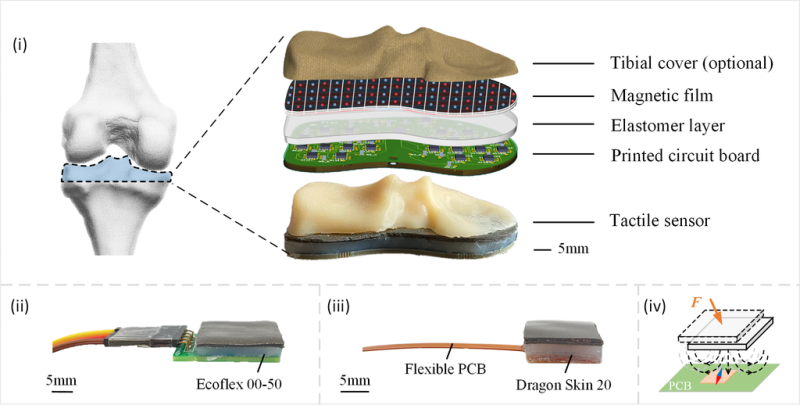
Configuration of the sensing element (three distinct versions) along with operational mechanism.
© Youcan Yan
These advancements carry considerable weight. For robots, incorporating these types of sensory components might result in devices that can execute intricate actions with a level of finesse similar to humans, becoming both quicker and more adaptable. Within medical fields, intelligent artificial limbs or joint supports may gain advantages from immediate force feedback mechanisms, ensuring they are safe as well as effective. Additionally, the straightforward production and adjustment processes for this sensor make widespread use likely across common scenarios, thus bringing sophisticated touch sensitivity into regular usage beyond research settings.
In the future, the LIRMM group aims to enhance the sensor by improving its materials and incorporating it into advanced systems such as humanoid robots. This development could close the gap between human agility and robotic accuracy, revolutionizing machine interaction within various environments.
For more information:
Yan, Y., Zermane, A., Pan, J. et al. Soft skin featuring taxels capable of independent three-axis force detection. Nat Mach Intell 6 , 1284-1295 (2024). https://doi.org/10.1038/s42256-024-00904-9
Source: CNRS INS2I
Similar topics
- This robot can handle any terrain 🐎
- When spherical robots work together using their visual tracking 🌐🤖👀
- These robots can modify their shape and stiffness as needed ⚙️
- This robot gains "conscious awareness" by looking at itself in a reflective surface 🤖